Industrial Wastewater Treatment
Ohio Lagoon Cleanup Project
Two Industrial Lagoons Cleaned in 5 Days – Service Life Extended from 5 to 15 Years
Project Overview
When this Ohio manufacturer evaluated their wastewater treatment costs, they discovered they were spending money on lagoon cleanouts three times more often than necessary. Standard dredging removed surface sludge but left residual material that accelerated re-accumulation—forcing cleanouts every 5 years instead of the lagoons' designed 15-year capacity.
We completed both lagoons in 5 days using polymer solidification technology, exposed the clay liner for the first time in 20 years, and extended their cleaning interval to 15 years—eliminating two future cleanouts and saving substantial operational costs.
Project Snapshot
Timeline:
5 days total (both lagoons)
Service extension:
5 years → 15 years (200% increase)
Cost avoidance:
Two complete cleanouts eliminated over 15 years
Liner access:
First full inspection in 20 years
| Detail | Specification |
|---|---|
| Location | Ohio |
| Facility Type | Industrial wastewater treatment |
| Lagoon Dimensions | 90' L × 140' W × 20' D (each) |
| Liner Type | Clay (requires inspection access) |
| Previous Method | Hydraulic dredging every 5 years |
| Challenge | Incomplete removal, no liner access, rising costs |
| Solution | Polymer solidification with complete excavation |
| Duration | 5 days (both lagoons) |
The Challenge:
Frequent, Expensive, Incomplete Cleanouts
This facility operated two clay-lined wastewater lagoons essential to their treatment process. For years, they relied on hydraulic dredging to maintain capacity—but the approach was creating multiple problems:
Operational Issues:
- Short service cycles – Cleanouts required every 5 years instead of the lagoons' 15-year design capacity
- Incomplete removal – Dredging equipment couldn't reach residual sludge, leaving moisture and material that accelerated re-accumulation
- No liner inspection – Residual sludge prevented access to clay liner, leaving potential leaks undetected
- High recurring costs – Frequent cleanouts meant repeated mobilization, equipment rental, and disposal fees
Why Dredging Failed:
Hydraulic dredging uses suction pumps to remove liquid sludge from lagoons. While effective for initial volume reduction, the method has significant limitations:
Incomplete extraction – Pumps can't remove the bottom 6-12 inches of material where sludge adheres to the liner
Residual moisture – Remaining wet material continues biological activity, accelerating new sludge formation
No surface preparation – Dredging doesn't expose or clean the liner surface, preventing inspection and reducing the time until the next cleaning
Limited access – Equipment operates from the lagoon edge, unable to reach corners or sloped areas effectively
The facility recognized they needed a better long-term solution and evaluated multiple contractors. U.S. Waste Industries was selected based on our polymer solidification technology and proven track record extending service intervals.
Our Approach:
Complete Removal with Polymer Solidification
Instead of surface dredging, we used a method that completely removes sludge down to the liner surface—transforming liquid waste into a stable solid that's safer to handle and prevents re-accumulation.
Step 1: Site Assessment and Planning
Our OSHA HAZWOPER-trained team conducted a pre-mobilization assessment covering:
- Sludge characterization – Depth measurements, composition analysis, and moisture content to determine polymer dosing rates
- Liner condition evaluation – Visual assessment of accessible areas to identify potential concerns
- Access and logistics – Equipment staging areas, haul routes, and disposal facility coordination
- Regulatory review – EPA and Ohio environmental compliance requirements, permit verification
- Timeline optimization – Work sequencing to minimize facility disruption
This assessment allowed us to develop a site-specific plan with accurate material quantities, equipment needs, and realistic timelines.
Step 2: Dewatering
Before sludge treatment, we removed standing water from both lagoons:
- Water was pumped down to expose the sludge layer
- Depending on discharge permits, water was either treated on-site or routed to the facility's wastewater system
- Final water removal continued until only sludge remained
Why dewatering matters: Polymer solidification works on sludge, not water. Removing free water first reduces the amount of treatment chemical needed and improves solidification effectiveness.
Step 3: Polymer Solidification
Once dewatered, we applied a proprietary polymer solidification agent directly to the exposed sludge:
How it works:
- Polymer chains bind with moisture particles in the sludge
- Chemical reaction occurs rapidly (minutes, not hours)
- Liquid sludge transforms into a firm, stable solid mass
- Material becomes non-leaching—metals and contaminants are locked in place
- Solidified mass can support equipment weight for safe excavation
Advantages over dredging:
- Complete removal possible – Solid material can be excavated down to the liner surface
- No re-liquefaction – Once solidified, material remains stable during handling and transport
- Reduced disposal volume – Polymer adds minimal weight (typically <5% volume increase)
- Safer handling – Eliminates liquid waste spills during loading and transport
- Faster execution – Excavation is faster than pumping, and multiple crews can work simultaneously
In this project, the polymer treatment was so effective that solidified sludge supported the weight of our excavators and wheel loaders without equipment sinking or creating access issues.
Step 4: Excavation and Removal
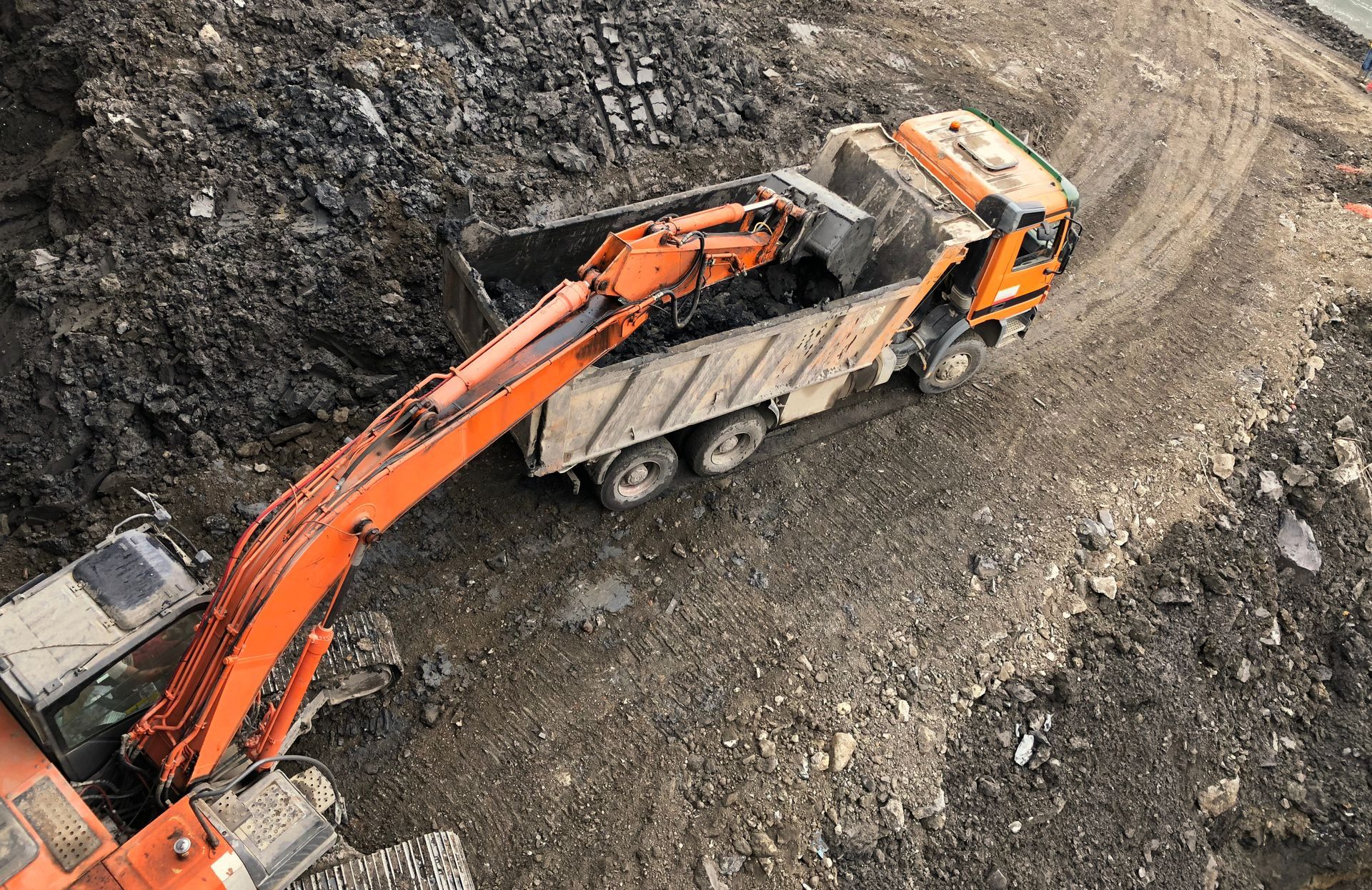
With sludge solidified, our crews used heavy equipment to systematically remove all material:
Equipment deployed:
- Excavators – Long-reach models for deep lagoon access
- Wheel loaders – For loading trucks and moving material within the work area
- Off-road forklifts – Maneuvering in soft or uneven areas
- Dump trucks – Continuous hauling to disposal facility
Process:
- Excavation started at one end and progressed systematically
- Material was loaded directly into trucks for immediate transport
- Corners, slopes, and edges were cleaned manually where needed
- Final pass removed any residual material, exposing the clay liner completely
Timeline: Both lagoons were completely cleared within 5 days of starting excavation—a dramatic improvement over the months-long dredging cycles previously used.
Step 5: Liner Inspection and Final Disposal
With lagoons empty for the first time in 20 years, the facility's engineering team was able to:
- Inspect clay liner integrity – Visual examination for cracks, erosion, or thin spots
- Document conditions – Photos and measurements for maintenance records
- Verify design specs – Confirm liner thickness and proper installation
- Plan repairs (if needed) – Identify areas requiring attention before refilling
Result: Liner inspection revealed no major damage, confirming that proper maintenance (complete removal vs. dredging) preserves liner life.
All removed sludge was transported to an EPA-approved disposal facility in compliance with Ohio environmental regulations. Complete manifests and disposal certifications were provided for the facility's compliance records.
Results:
Extended Service Life and Substantial Cost Savings
The polymer solidification approach delivered measurable improvements across every project metric:
Timeline and Efficiency
- 5 days – Total project duration for both lagoons (dewatering through final cleanup)
- 15 years – New projected cleaning interval (up from 5 years)
- 200% increase – In time between required cleanouts
Financial Impact
- Two cleanouts eliminated – Over the next 15 years, the facility avoids two complete cleaning projects
- Reduced disposal costs – Polymer treatment added minimal volume (<5%), keeping hauling and tipping fees low
- Minimal downtime – 5-day turnaround meant wastewater treatment resumed quickly
Operational Benefits
- First liner inspection in 20 years – Confirmed structural integrity and informed long-term maintenance planning
- Restored full capacity – Complete sludge removal returned lagoons to original design volume
- Cleaner surface – Exposed liner prevents residual material from accelerating new buildup
- Compliance confidence – Full documentation provided for EPA and state regulatory records
Long-Term Value
By switching from dredging to polymer solidification, this facility:
- Restored lagoons to their designed 15-year service capacity
- Avoided approximately $150,000-$200,000 in future cleaning costs (industry-standard estimates for two additional cleanouts)
- Gained visibility into liner condition, enabling proactive maintenance
- Reduced operational disruption from frequent, lengthy cleaning cyclesThe polymer solidification approach delivered measurable improvements across every project metric:
Timeline and Efficiency
5 days – Total project duration for both lagoons (dewatering through final cleanup)
15 years – New projected cleaning interval (up from 5 years)
200% increase – In time between required cleanouts
Financial Impact
- Two cleanouts eliminated – Over the next 15 years, the facility avoids two complete cleaning projects
- Reduced disposal costs – Polymer treatment added minimal volume (<5%), keeping hauling and tipping fees low
- Minimal downtime – 5-day turnaround meant wastewater treatment resumed quickly
Operational Benefits
- First liner inspection in 20 years – Confirmed structural integrity and informed long-term maintenance planning
- Restored full capacity – Complete sludge removal returned lagoons to original design volume
- Cleaner surface – Exposed liner prevents residual material from accelerating new buildup
- Compliance confidence – Full documentation provided for EPA and state regulatory records
Long-Term Value
By switching from dredging to polymer solidification, this facility:
- Restored lagoons to their designed 15-year service capacity
- Avoided approximately $150,000-$200,000 in future cleaning costs (industry-standard estimates for two additional cleanouts)
- Gained visibility into liner condition, enabling proactive maintenance
- Reduced operational disruption from frequent, lengthy cleaning cycles
TECHNICAL COMPARISON
Why Polymer Solidification Outperforms Dredging
Many facilities assume dredging is the only option for lagoon maintenance, but it's often the least effective long-term solution. Here's the technical comparison:
| Factor | Hydraulic Dredging | Polymer Solidification |
|---|---|---|
| Sludge removal | Incomplete—leaves 6-12" residual layer | Complete—exposes liner surface |
| Liner access | Limited—residual material prevents inspection | Full—liner completely exposed |
| Re-accumulation rate | Faster—residual sludge accelerates buildup | Slower—clean surface extends service life |
| Handling safety | Higher risk—liquid waste can spill during transport | Lower risk—solid material safely contained |
| Volume increase | None (removes liquid as-is) | Minimal (<5% from polymer addition) |
| Environmental risk | Moderate—potential for leaching during transport | Low—non-leaching solid mass |
| Equipment access | Limited—pumps operate from edge only | Full—excavators can work entire surface |
| Service interval | Short—5-7 years typical | Extended—12-15+ years achievable |
| Long-term cost | Higher—frequent cleanouts required | Lower—extended intervals reduce lifetime expense |
Bottom line:
Polymer solidification costs slightly more per cleaning but dramatically reduces cleaning frequency—delivering net savings and better operational continuity.
Industries and Applications
U.S. Waste Industries provides lagoon cleaning and polymer solidification services for industrial and municipal facilities, including:
Manufacturing:
- Chemical processing wastewater
- Metal finishing and plating
- Food and beverage processing
- Pulp and paper mills
Agriculture:
- Livestock and poultry operations
- Dairy waste lagoons
- Food processing byproducts
Energy and Utilities:
- Power generation facilities
- Municipal wastewater treatment plants
- Industrial pretreatment systems
Common lagoon types we service:
- Clay-lined lagoons (like this project)
- Synthetic liner systems (HDPE, EPDM)
- Concrete-lined basins
- Unlined settling ponds (where permitted)
Services Demonstrated in This Project
This Ohio lagoon cleanup showcased multiple technical capabilities:
- Pond and lagoon cleanout services – Complete dewatering, solidification, and excavation
- Polymer solidification technology – Proprietary treatment for volume reduction and complete removal
- Heavy equipment mobilization – Excavators, loaders, trucks, and specialized lagoon access equipment
- Hazardous and non-hazardous waste management – Proper characterization, manifesting, and disposal
- Compliance documentation – EPA reporting, disposal certifications, and regulatory coordination
REQUEST A QUOTE FOR LAGOON ASSESSMENT OR TREATMENT
Help us give you an accurate quote:
Tell us your lagoon size, how deep the sludge is, and what type of liner you have. Photos and site maps help too. You can upload them with your quote request.
Don't have all the details?
That's okay. Fill out what you know now. We'll work with you to get the rest.
Related Lagoon Cleaning Projects & SERVICES
Virginia Lagoon Removal
8,000 tons removed in 7 days after another contractor failed for 12 months
Virginia Lagoon Removal
8,000 tons removed in 7 days after another contractor failed for 12 months